"Every woman in Medieval Rus' was expected to be able to sew and embroider. Diligence at handiwork was considered to be a special virtue. It is no wonder that the famous work of the 16th century, the Domostroj, which contains the various rules of 'worldly wisdom,' particularly emphasizes that 'good wives do needlework.' Embroidering liturgical podeai was considered to be pious work. It was considered a feat if a woman 'spent all night without sleep in prayer and needlework, in spinning and handiwork.' With this closed lifestyle which a woman of Medieval Rus' (especially in the upper classes) led, handiwork was almost the only area of creativity available to her. It was not by chance that foreigners arriving in Russia noted: 'The best thing that women can do here is to sew well and embroider excellently in silk and gold.'"
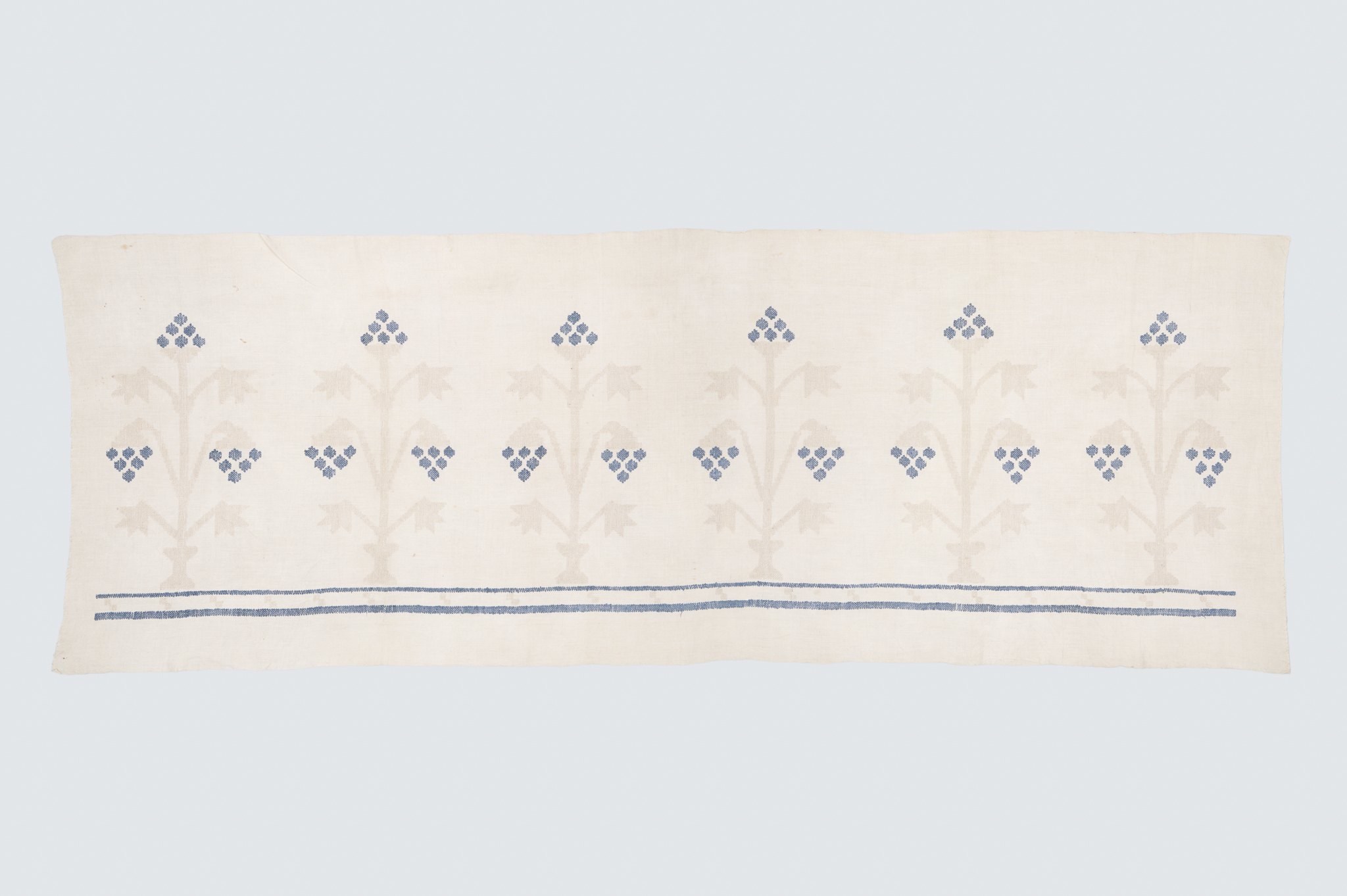
While this particular tradition refers to embroidery practices hundreds of years before this piece was created, it speaks to the long standing practice of using embroidered textiles to adorn the Russian Orthodox Church. In Russian Orthodox practice, an altar set includes numerous parts: a kalimata set comprised of two chalice veils and an aer, an altar tablecloth, a Proskomedia table (the Table of Preparations) cloth, and an Analogion/Tetrapod tablecloth. In addition, icon stand covers, Gospel Book covers, vestment covers, Communion cloths, and podeai all adorn the chapel as well. It is hard to know where in the panoply this cloth may have been used; its simpler 'folk' style could suggest it was used at a home altar rather than in the more formal church setting, or the grapes and vine motif could suggest it was intended for the Table of Preparations, where Communion offerings rest during the service. Regardless, this beautiful textile speaks to the skill of the woman (or women) who spun, wove, and embroidered this cloth, and who likely saw this process as an act of devotion.