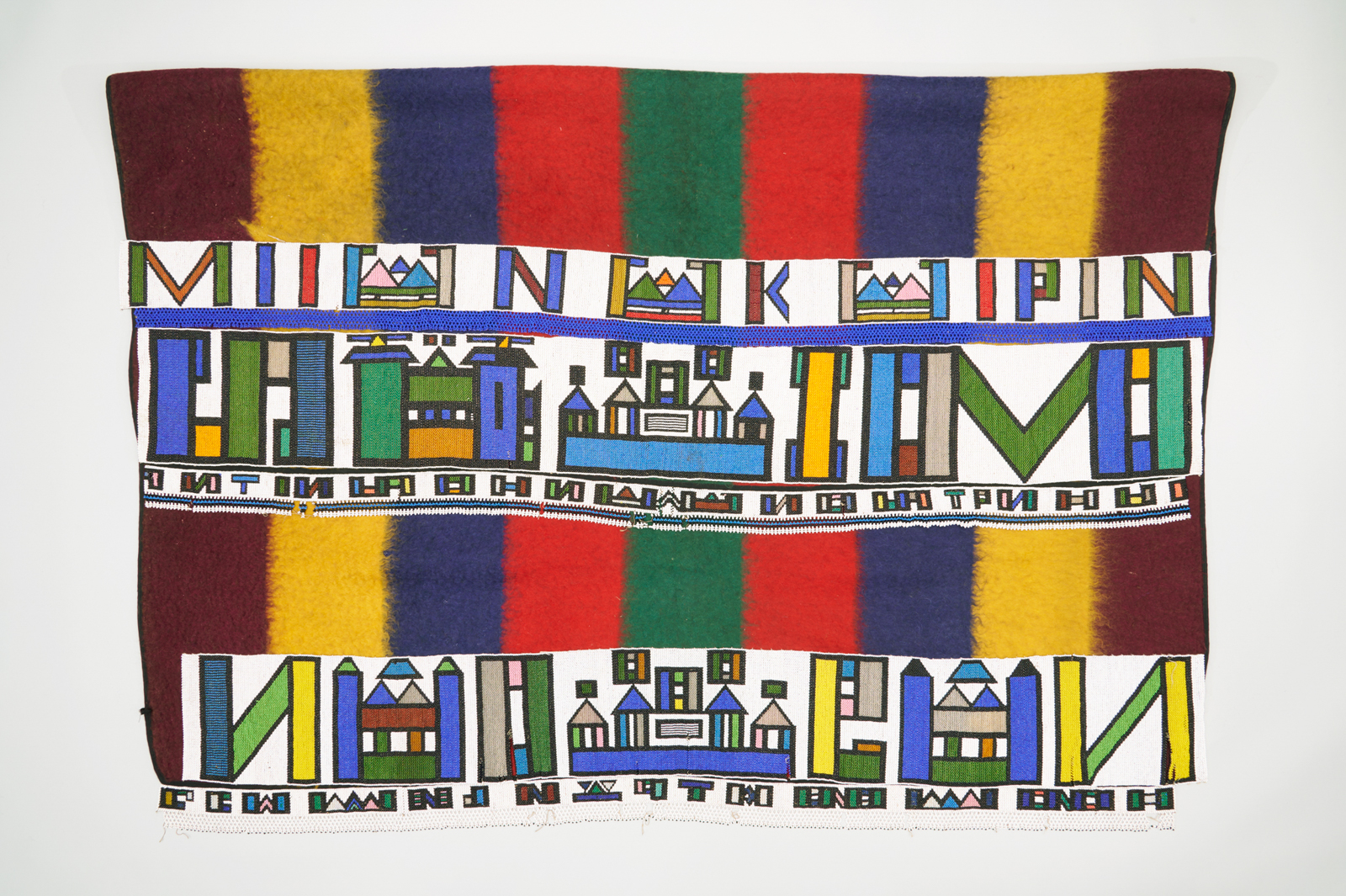
"In a successful attempt to retain their cultural identity..., the Ndzundza Ndebele developed the arts of house painting and beadwork, using bold geometric patterns in both areas. Their beadwork also incorporates stylized images of flora and fauna and representations of the houses themselves. Ndebele beadwork from the 19th century is mainly made up of closely worked white beads with only sparse coloured details. As the 20th century progressed, more and more coloured beads were used. In the 196os a new range of European beads was adopted. By that decade there was a tourist market for the beadwork that encouraged bold new eye-catching designs.
Women carry out their beadwork not only during the quiet months of winter, but also whenever they have a spare moment at other times of the year...Women will work Czech beads into capes, belts, aprons, and even the edging of trade blankets...At the end of a girl's initiation into womanhood, she is presented with an isephephetu, a stiff, beaded apron that symbolizes her change of status. On her marriage she dispenses with this apron, replacing it with the umaphoto, a large, beaded goatskin apron. At her wedding she will wear a dramatic beaded cape known as a linaga and, sometimes, a striped woolen 'Middleburg' blanket edged with broad bands of beadwork. Ndebele men seldom wear beadwork ornaments" (2003:221).
The "Middleburg" blankets are named after one of the largest towns in the area historically occupied by present-day Ndebele communities. While this blanket was commercially produced, intended for the international market, this type of blanket, also called a marriage blanket, could be worn by a woman at her wedding, as described above. You can see another example of a marriage blanket at the