97-51-3
1 media/97-51-3_thumb.jpg 2024-08-07T12:52:04+00:00 Jessica Nelson 9a5eb8d4bf9f59a8ae5935bcd61eb6b29c513138 2 2 Shisha Embroidery Panel (Indian); image by Juan Arce plain 2024-08-27T01:23:26+00:00 20240522 152935 20240522 152935 Jessica Nelson 9a5eb8d4bf9f59a8ae5935bcd61eb6b29c513138This page is referenced by:
-
1
2024-09-02T23:38:37+00:00
Shisha Ganesha Wall Hanging (Indian)
3
plain
2024-09-19T14:40:14+00:00
Maker Once Known, Indian People (India)
Shisha Ganesha Wall Hanging (n.d.)
cotton, silk, mirrored glass, ink
64.5 x 60.0 cm
Gift of James and Alice Houston
97-51-3
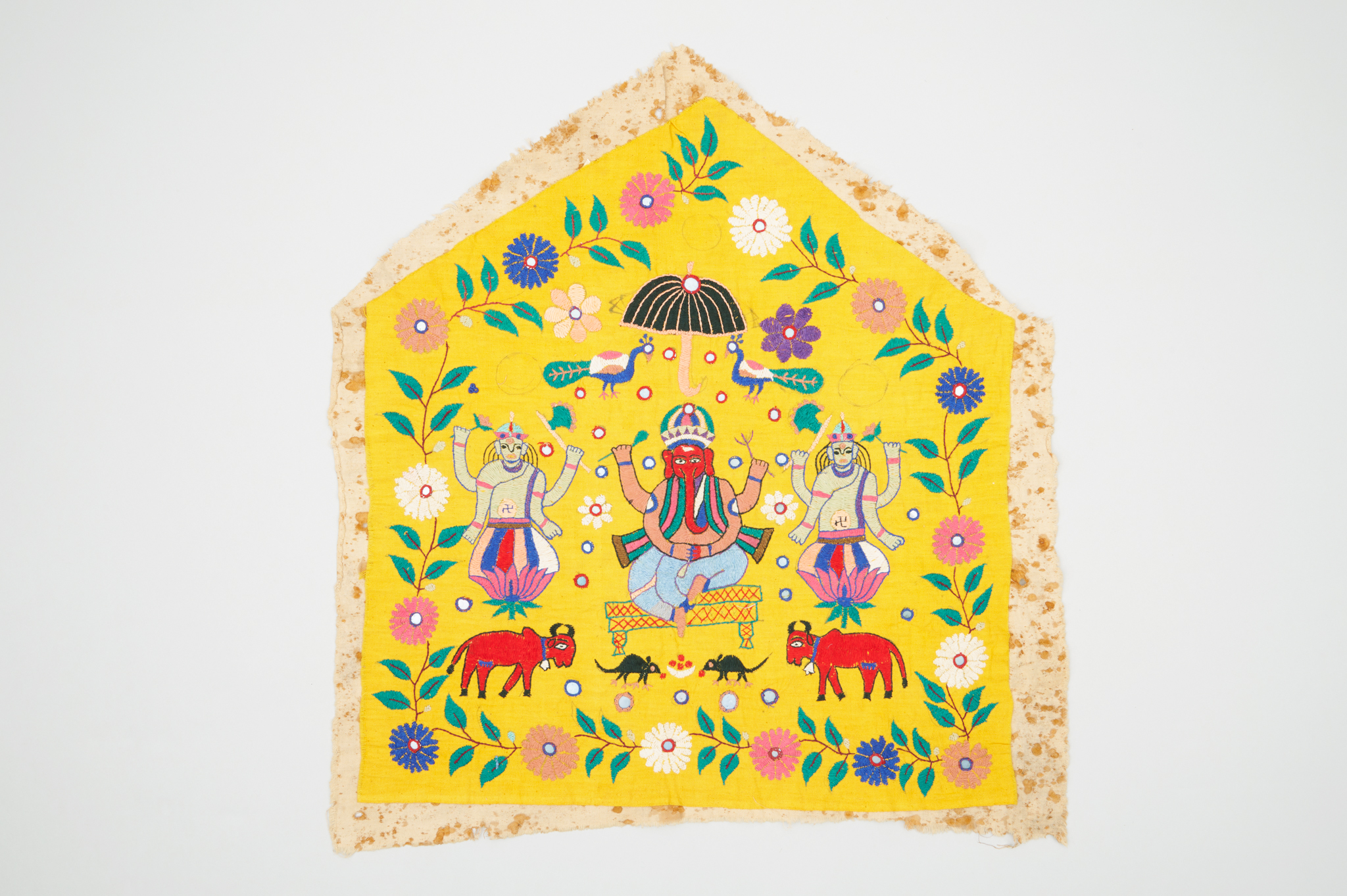
This is an example of Shisha embroidery, a decorative style favored in "India's north western states, with Kutch, a district of Gujarat, a particularly rich source." Described in a V&A exhibit on Indian Embroidery, Shisha can be characterized by the use of small round mirrors embedded within embroidered designs. This practice was not purely decorative "as some communities believe mirrorwork is auspicious as a tool for warding off the evil eye, reflecting bad luck and evil spirits away from the wearer." While early examples of Shisha work may have used naturally occuring reflective materials, like mica, with the widespread availability of first blown glass and then pressed glass mirrors, Shisha craftspeople had plenty of material to work with by the 19th and 20th centuries. Shisha crafters will take mirrored glass and cut it using special dampened scissors (to prevent shattering) into the desired shapes.
This V&A exhibit has a remarkably similar piece to this one in the exhibition, a wall hanging, with the same pentagonal shape and featuring the same subject matter. Both feature Ganesha, the Hindu elephant headed god of beginnings, prosperity, wisdom, and luck amongst other things. According to legend:"One day Goddess Parvati was at home on Mt.Kailash preparing for a bath. As she didn’t want to be disturbed, she told Nandi, her husband Shiva’s Bull, to guard the door and let no one pass. Nandi faithfully took his post, intending to carry out Parvati’s wishes. But, when Shiva came home and naturally wanted to come inside, Nandi had to let him pass, being loyal first to Shiva. Parvati was angry at this slight, but even more than this, at the fact that she had no one as loyal to Herself as Nandi was to Shiva. So, taking the turmeric paste (for bathing) from her body and breathing life into it, she created Ganesha, declaring him to be her own loyal son. The next time Parvati wished to bathe, she posted Ganesha on guard duty at the door.
In due course, Shiva came home, only to find this strange boy telling him he couldn’t enter his own house!...Seeing that this was no ordinary boy, the usually peaceful Shiva decided he would have to fight him, and in his divine fury severed Ganesha’s head, killing him instantly. When Parvati learned of this, she was so enraged and insulted that she decided to destroy the entire Creation! Lord Brahma, being the Creator, naturally had his issues with this, and pleaded that she reconsider her drastic plan. She said she would, but only if two conditions were met: one, that Ganesha be brought back to life, and two, that he be forever worshipped before all the other gods.Shiva, having cooled down by this time, and realizing his mistake, agreed to Parvati’s conditions. He sent Brahma out with orders to bring back the head of the first creature he crosses that is laying with its head facing North. Brahma soon returned with the head of a strong and powerful elephant, which Shiva placed onto Ganesha’s body. Breathing new life into him, he declared Ganesha to be his own son as well and gave him the status of being foremost among the gods, and leader of all the ganas (classes of beings), Ganapati.
In this wall hanging, the figure of Ganesha is centered, flanked by two figures, perhaps his wives Buddhi and Siddhi or manifestations of Shiva, and the bull Nandi appears twice in the foreground. These embroidered figures are surrounded by Shisha mirrors, and floral motifs, while rats, a symbol associated with Ganesha, appear at his feet and peacocks hover above. This is all embroidered on a yellow field, which "is the colour associated with the Muladhara chakra, where the kundalini resides, and Ganesha is the deity who guards this chakra." This piece is imbued with meaning, and it may have been intended to hang in a home or shrine. Hints of ink in the upper segments of the textile, along with the exposed backing fabric peeking out along the sides, suggest that this piece was never completed.