Priest's Vestment (Gurage)
Maker Once Known, Gurage People (Ethiopia)
Priest's Vestment (20th century, pre-1974)
velvet, cotton cloth, yarn
95.0 x 206.0 cm
Gift of Haven Starr
95-22-17
This piece is identified in our records as a priest's vestment and associated with the Gurage people of Ethiopia, but it remains something of a puzzle to us. Research into the cultural practices of Gurage communities suggests that as most Gurage are either Christians (members of the Ethiopian Orthodox Tewahedo Church) or Muslims, the most likely priest to be wearing vestments would be in the Ethiopian Orthodox Tewahedo Church. Researching the vestments used within the Ethiopian Orthodox Tewahedo Church led to this description of priestly garb:
While this vestment, which features a rectangular base with five tabs hanging from lower back and one at either side, which hang down in front when worn, with a cord and loop sewn at inside top to tie around neck, could be a version of a Stole, it doesn't match any examples or forms we've been able to find. The design, which depicts a crowned lion and flag, flanked by round applique shields, and with geometric designs around it, also isn't a typically Christian liturgical motif as usually appears on Stoles in the Ethiopian Orthodox Tewahedo Church. Further research into the religious practices of the Tewahedo Church added the possibility of this being a wall hanging, rather than a vestment, as tapestries, wall hangings, murals and other forms of art adorn Churches in Ethiopia, and play an important role in illuminating Ethiopian Orthodox Tewahedo Church ceremonies. With the combination of applique and machine chain-stitched embroidery in brightly colored yarns, forming lines around elements and filling in large areas within elements (like the body of the lion), this cloth would be a marked departure from the woven tapestries that feature in church decorations, but could still potentially fit with a designation as wall hanging."The vestments worn by the priest at Mass are as follows: The Alb (Qamis); the cuffs (Akman); the Girdle (Zenar), the Chasuble (Qaba Lanqa), the Stole (Motahet), and the Cap (Qob).
The deacon's vestments are the Stole, the mitre and the Long Tunic corresponding to the Alb.
The Bishop, in addition to the priest's garments uses a crown and a pastoral staff ending in two entwined serpents with a cross between them and carries a small hand cross with which to bless the people. He also wears a pectoral cross and medals." - Aymero W and Joachim M
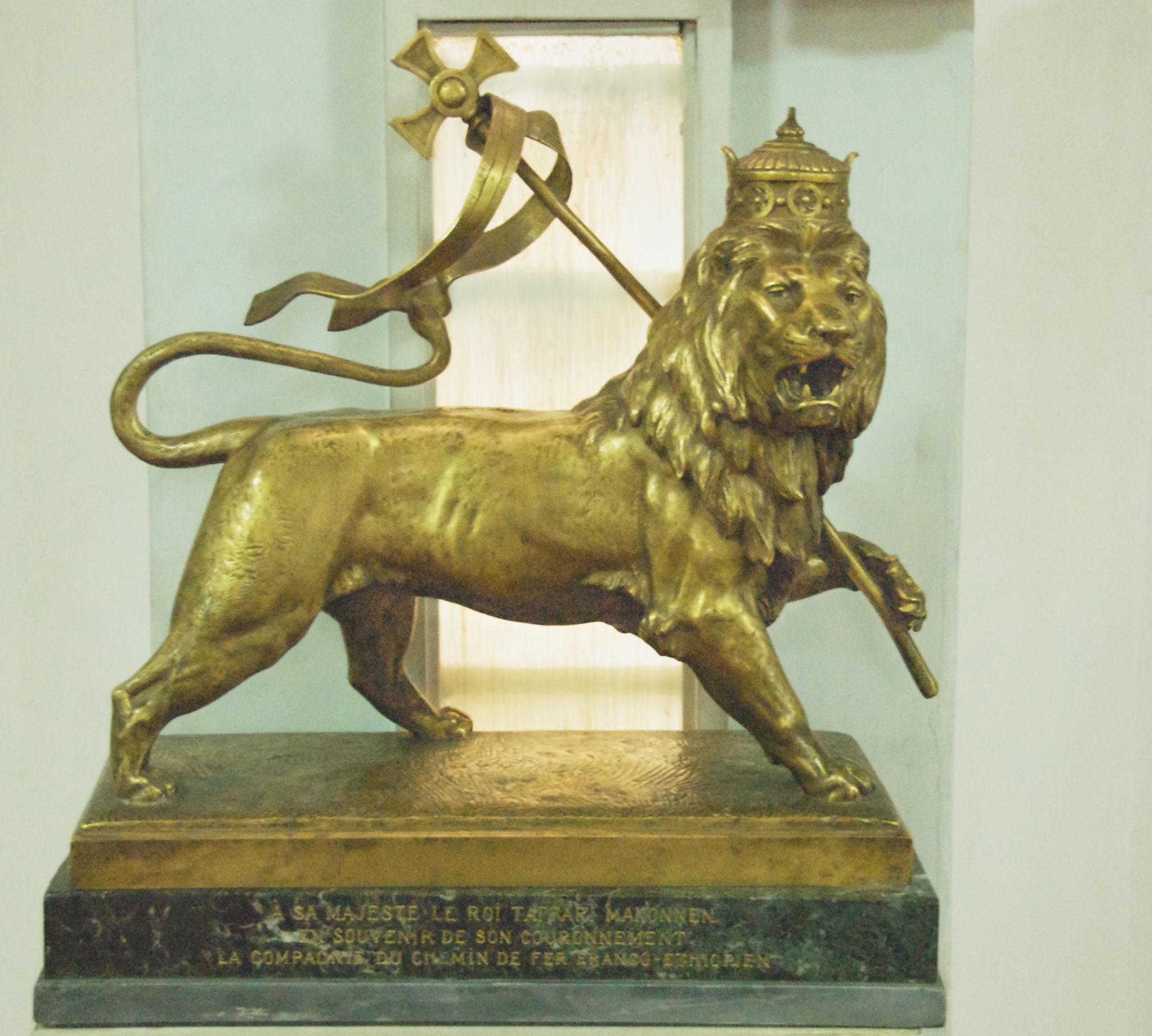
However, research into the iconography of the crowned lion and flag design identified this as The Lion of Judah, the national symbol of Ethiopia. According to a description of a Lion of Judah statuette given to then President Kennedy by Haile Selassie, Emperor of Ethiopia during a state visit, "The Lion of Judah is the national symbol of Ethiopia, and 'Conquering Lion of the Tribe of Judah' is the title of every Ethiopian Emperor. King Haile Selassie referred to himself as the conquering lion of the tribe of Judah. As this lion wears the royal crown, it may be a representation of the Emperor himself." The Lion of Judah remained the national symbol of Ethiopia from 1897 until 1974 when the last Emperor Haile Selassie was deposed. Given the close association between the Emperor and this symbol which appears prominently on the vestment, perhaps this cloth needs to be viewed in a more secular light, as an element of court garb or as a wall hanging to be associated with court or governmental ceremony.
So what is this object? We remain a bit stumped, and acknowledge that it is impossible to be experts in everything. We welcome insight from others who may be more familiar with this material; please get in touch with us so we can continue to learn together about the objects in our care.
This page has paths:
- Spiritual Iconography and Ceremonial Objects Jennie Smithken-Lindsay