Aksu (Overskirt) (Quechua)
Off the Roll: Highlights of a Global Textiles ProjectMaker Once Known, Quechua People (Potolo, Bolivia)
Aksu (Overskirt) (pre-1980)
alpaca wool, dye
63.0 x 52.0 cm
Purchased with Haffenreffer Special Fund
80-101
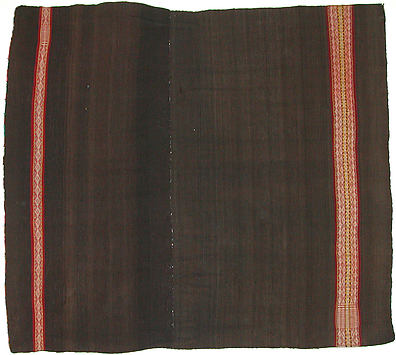
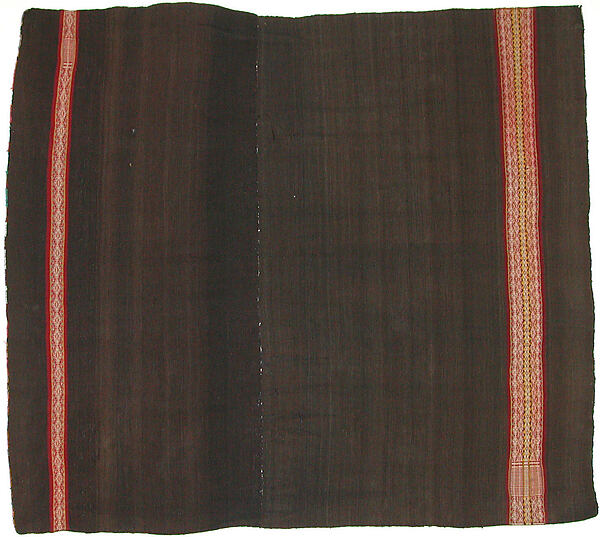
This is half of an Aksu, or women's overskirt in the Quechua language of the Potolo area of Bolivia. As explained in Aymara Weavings, "the aksu was worn wrapped around the body, with one corner pulled under the arm and another pulled over the opposite shoulder, with the two corners pinned together in front. It was gathered at the waist where it was secured by a belt. It only covered three-quarters of the body but its bloused bosom area was still used for carrying items" (Anderson & Tracht 1983:112). As you can see from this aksu at the Met, when complete the aksu is comprised of two panels of cloth, joined at a center seam, and these panels may be identical or may feature one dominant decorative panel complimented by a simpler panel with limited decoration. Given the intricacy of detail on this half of the aksu, it is likely this was the fancy half of the textile. The weaver of this piece created a plethora of bird motifs in the red, green, and black weave using a complimentary warp uneven twill technique, married with smaller stripes of pebble weave to create the crisp designs seen in the narrow stripes. In addition to the many birds, close examination of the pebble weave stripes reveals stars, lizards, and a variety of geometric designs. For all the lovely decoration woven into this cloth, the aksu was still a utility garment for its wearer, providing a handy "pocket" in which to stow objects as needed. If an aksu became too worn in places, a woman could pick apart the seam between the garment sections and either replace the worn panel or reattach the panels in a flipped configuration, the better to hide or redistribute wear.
This page has paths:
- Creatures - Real and Imagined Jennie Smithken-Lindsay
- Clothing - Wearable Art Jessica Nelson